Thursday, July 29, 2010

July 2, 2010 Manggis, Bali: Bumbu Bali


As I mentioned in the cooking class blog, Bumbu Bali is the spice mix that defines Balinese cooking and gives it the richness and complexity that has captured my imagination and my taste buds. And it is so fun to say. It sounds like Boom Boom Bali and I couldn’t keep myself from saying it over and over, like an incantation. Boom Boom Bali. Boom Boom Bali.

You may be saying to yourself, "I would never in a thousand years make this." I must admit that I am still weighing the time considerations against the flavors which I love. What I find fascinating is that on the island of Bali, and probably many other islands in Indonesia, women are getting up every day and putting this together for themselves and their families. Of course the ingredients are readily at hand for them, but still I am in awe of the work involved and the sophistication and elegance of the result.

The ingredients include:

Ginger, galengal, and fresh turmeric (clockwise from upper left). I have found these three at Ranch 99 in Richmond or Berkeley Bowl.

Kencur, also known as aromatic ginger or lesser galengal, in a basket at the market. I haven't been able to find this in the US. I have substituted a little more ginger and more galengal.
Hot red chiles come in several different forms. The smaller ones, sometimes known as bird's eye chiles, are incredibly hot. I use slightly larger ones, like jalapenos, which are still plenty hot but not impossible. I often reduce the number I include until I know how hot they are.
Tamarind can be found in lump form like this or often in small jars as tamarind paste. It can be found in stores selling Indian foodstuffs. It has a wonderful tart flavor.
Palm sugar in Bali comes in these cakes. I've only been able to find it in a jar in the US.
Shrimp paste is used quite sparingly in Balinese food. It has a very strong flavor and an even stronger smell. In the US it comes very well wrapped---for good reason.
Candlenuts, shown here on the lower right, are very much like macadamia nuts. Whole nutmegs are in the middle of the plate. The shell needs to be removed to get to the nut which can be grated and is far superior to anything you can find in ground form. Peanuts and green, black, and red beans encircle the nutmegs.


Dried salam leaves and garlic are at the top of this picture. A lemongrass stalk is on the left. The stalk with a bud on the end is a ginger flower, not used in Bumbu Bali. Galengal, kencur, and fresh turmeric are the roots. Several kinds of peppers. And tucked in the middle are small Bali limes and perhaps a shallot or two.

Traditionally most of these ingredients would be ground together on a daily basis in an ulekan, a mortar and pestle made from lava stone, readily available in this volcano-rich country. Apparently some Balinese women, feeling pressed for time, have resorted to blenders to speed up the process. But clearly this method is frowned upon by our chef. I must admit that both times I have made it (before the trip and after the trip), I have used a blender and my less sophisticated Balinese palette thought the result was just fine—splendid even.

The paste is heated in oil over a fire, water is added, and it is simmered along with crushed lemongrass and salam leaves until it is much reduced. Once it has cooled, it is ready to use.

Wednesday, July 28, 2010

July 2, 2010 Manggis, Bali: The Cooking Class

When we returned to the hotel from our visit to the market, we found the large center table in the dining room set up with burners, ulekan stones for grinding, woks, and ingredients laid out in small plastic dishes. We each donned an apron and settled into a work station.

After a short introduction to the ingredients we would be using and the various kinds of rice (5 out of the 12 kinds grown in Bali) and beans available in Bali, our first task was to make Bumbu Bali, a splendid combination of ginger, garlic, shallots, kencur, galengal, fresh turmeric, lemongrass, hot red chiles, candlenuts, nutmeg, tamarind, palm sugar, dried salam leaves, and shrimp paste. These ingredients, ground into a paste, form the basis for many Balinese dishes. Look at the next blog for more information and pictures.

Once the Bumbu Bali was simmering, we began to work our way through the remaining recipes, carefully following Chef Santika’s instructions.

Sate ayam, Chicken Skewers and Bumbu kacang, Peanut Sauce. These are the very same skewered bits of chicken you can find at any Thai restaurant. Peanut Sauce isn't really necessary because the chicken is marinated in the Bumbu Bali before being grilled. However, our chef chose to teach it to us because he knows that foreigners are so fond of it. Just delicious.

Cumi cumi isi bumbu Bali, Braised Squid Filled with Chopped Prawns. The top part of the squid is used as a pocket, filled with finely chopped prawns, closed with a toothpick, and steamed quickly. Meanwhile a sauce of Bumbu Bali, coconut milk, red chiles, tamarind paste, sweet soy sauce, and oyster sauce is simmered together. Before serving, it is poured over the squid.

Kare tahu dan tempe, Curry of Tofu and Soybean Cake with Long Beans and Jackfruit. Long beans are green beans almost a yard long.  I think they're tastier than our regular short green beans. The curry sauce is composed of Bumbu Bali, coconut milk, lemongrass, and a salam and a lime leaf. Once the tofu, tempe, and whatever vegetables you desire are stirred in, you can season it with tamarind, sweet soy sauce, and regular soy sauce. I loved the tofu part—I’m not so sure about tempe.

Sayur daun singkong, Cassava Leaves Braised in Coconut Milk. We stirred together the Bumbu Bali with a tomato and salt and then added the coconut milk and lemongrass until we had a delicious sauce to which we added greens (cassava or spinach or fern tips), the sweet soy sauce and some tamarind. This was a wonderful dish.

Nasi goreng, Indonesian Fried Rice. Each of us made our very own Nasi goreng using our wok and burner. When we finished, we packed the rice, chicken and shrimp mixture into a coconut shell bowl and turned it over onto our plates, forming a nice round mound. We decorated the mound with deep fried shallots and strips of egg.

The lunch was fantastic.

July 2, 2010 Klungkung, Bali: To Market, To Market

The four of us, Katherine, Ben and Stephanie, and me, signed up to take a Balinese cooking class taught by chef Nyoman Santika at our hotel. The class itself was preceded by a trip to the large market in Klungkung, maybe a thirty-minute drive from the hotel.

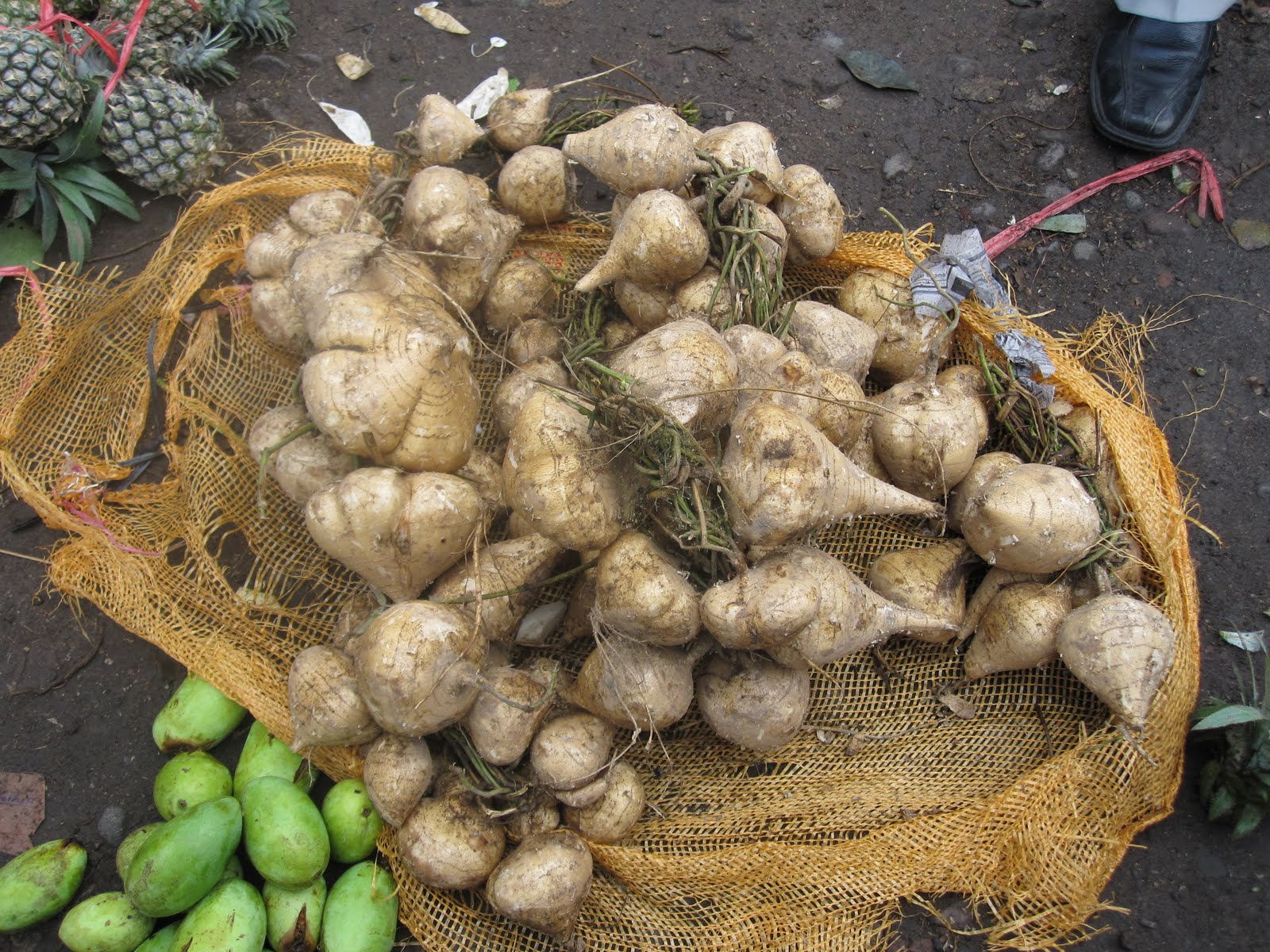
The market was just splendid: an incredible mixture of fruits, vegetables (jicama pictured), cooking oil in reused water bottles, fish, live animals, beans, snacks, sundries, and cooking equipment. We didn’t get close to the slaughtering area—steered clear by our concierge and guide, Ardika, who must have been worried about our squeamish foreign stomachs.


I had taken along the list of ingredients I was trying to find in Berkeley that would enable me to cook Balinese food at home. I had been surprisingly successful at Ranch 99, an Asian mall and grocery store in Richmond, and at the Berkeley Bowl. But there were a few things on my list that I hadn’t been able to find and had no idea what they looked like. All questions were answered during the course of the market visit. It was great.

This market opens around 1:00am—yes, that’s right. 1:00am. Traditionally women, who are the primary cooks in the households, get up very early to do their shopping and come back home to cook the food before preparing the offerings for the day. (Men cook for ceremonies because the women are occupied with making more complicated offerings.) The food pretty much stays on simmer for the day. Whenever a family member is hungry, he or she will come into the kitchen, prepare a bowl of food, and retire to a quiet spot to consume it. The family doesn’t all sit down to eat at the same time except on ceremonial occasions (which are pretty numerous in this culture).

This custom of eating the same food whether it is early morning or late in the afternoon explains what I noticed on our hotel menus. Some of the dishes were offered on all three menus: breakfast, lunch, and dinner. Mie goreng (Stir Fried Noodles with Vegetables) and Nasi goreng (Fried Rice) in various forms were available at all three meals. Being a person who loves savory dishes for breakfast, I couldn’t have been happier. Many dishes are offered for both lunch and dinner with no difference in the size of the servings. Jererak ayam (Chicken in Coconut Sauce), for example, was available for lunch and dinner. It seems that porridges with a rice base are most often offered for breakfast, although porridges and soups show up on lunch menus as well.

In almost every village you pass through, you’ll see roosters in bamboo cages, like large loosely-woven baskets turned upside down over the roosters. The market at Klungkung was no exception. Turns out these roosters are used in ceremonial fights to the death on special temple occasions but are also used in village contests which involve gambling, illegal in Bali. The illegality doesn’t seem to stop the fights. In the market there was a circle of men holding their prized roosters. They let two loose to “practice.” As soon as the cocks got too close to each other, the owners scooped them up.

Back to the hotel for our cooking class.

July 1, 2010 Manggis, Bali: A Trek through the Rice Fields

Three of us from the hotel, Katherine, Bev from Adelaide, Australia, and me, set out with our guide Toto to take what we thought was an easy walk through rice paddies, scheduled to take two hours and twenty minutes.

In the van on the way to the trail head, we saw monkeys and ducks on the road and close by two golden cows and their master plowing a field. “We are not in Hawaii,” we said to ourselves.

Shortly after we reached the trail and our van with umbrellas disappeared into the distance, it started to rain—improbably and unexpectedly given that June and July are not part of the rainy season. Our guide, ever resourceful, cut each of us a banana leaf to hold over our heads. Problem solved. And off we went.

Over a rickety bamboo bridge, up a steep trail to a water channel used for irrigating the rice paddies, and through the rice paddies themselves.

These rice paddies have been terraced in these hills for more than a thousand years. The water system, a complex and ingenious network of irrigation channels, tunnels and aqueducts, is organized into water-sharing communities called subak. These regional communities make the decisions that determine how the water is allocated for each field under cultivation. Given that rice is the primary staple of the Balinese diet, the success of the crop is extremely important and water is, of course, crucial.

Looking at these terraces there is nothing to remind us of the 21st century: men working the fields by hand, no visible power lines, lunch carried to them on a fellow villager’s shoulders. (Lunch is wrapped in plastic but that’s it.)

All along the way Toto told us stories about the flora and fauna. He has a wealth of information at his fingertips and we were enthralled: red pineapples, mimosas closing up with our touch, shrines to the rice goddess, Dewi Sri, all the uses of coconut palms, etc. I am standing next to a rice goddess shrine.

About mid-way, the 21st century happily resurfaced in the form of a small shop with a much-appreciated outdoor toilet. An elderly fellow was playing a bamboo instrument called a rindik.

We continued through a small village whose clean water system was built by Engineers without Borders and then down an impossibly narrow, stony, and slick trail to the ancient village of Tenganan where pigs and sacred black cows were making themselves perfectly at home in the streets and temples.

We stopped along the main street to visit the studio of a weaver whose specialty was double ikat.

Back at the hotel four and a half hours from our departure—about two hours longer than anticipated, refreshed with frozen towels provided by the driver of our van, we are weary but proud trekkers. I am hugely grateful to Toto who held my hand down the trail, step by precarious step. It was a marvelous adventure.

Tuesday, July 27, 2010

June 29, 2010 Ubud to Manggis: The Cremation

July is the cremation season in Bali. Typically when someone dies, he or she is buried. When the village or collection of villages has saved enough money to stage a cremation, the bones of the deceased are dug up, wrapped in various ways and carried in procession to the cremation site.
At the site, paper animals of various sorts are waiting under the palm trees to hold the bones and offerings.

Gamelan music from two groups envelopes the area in sound.
Families mill about holding photographs of the deceased, spreading out picnics, and having a good time. Ultimately the bones are burned. This simple description in no way conveys the magnificently beautiful chaos of the festival. And it is a festival. The burning of the bones allows the spirit of the deceased to reincarnate in another family member so there is good reason to celebrate.

In order to attend, we had to garb ourselves appropriately. There were several purveyors on hand more than willing to wrap sarongs around us (long pieces of brightly-colored cotton fabric), tie them in place with silky sashes and give Ben the suitable head gear. While we didn’t exactly fit in, we were mostly ignored in a very pleasant sort of way. Inclusion is a basic tenet of the Balinese culture and we were included with absolutely no fuss or bother.

We wandered around for several hours, watching, listening, wondering when something was going to happen. Just like everyone else. Because we were on the way to our next hotel and had several more hours to drive, we left before the burning which apparently isn’t as dramatic as we had imagined. More like a smoldering than a conflagration. Still we were sorry to miss it.

June 28, 2010 Close to Ubud, Bali: Street Food

On the way back to the hotel from our expedition, still pretty buzzed from the coffee, we stopped at a road side store so that Ben could purchase some Balinese beer and a package of clove cigarettes to bring back to a friend. Outside the store was a small food cart with a very cute young fellow hanging out, waiting for business. We ordered a king-sized omelet—without having the faintest idea what that might turn out to be. It cost 23,000 Indonesian rupieh or about $2.30. Basically I wanted (1) to give this young fellow some business (2) to eat some street food for which Bali is famous and (3) to see what he would produce and take pictures of the process. I was successful on all fronts.

First he mixed up some eggs and green onions in a metal cup.


Next he twirled the pastry until it was incredibly thin, slipped it into some hot oil, and poured the egg mixture into the middle.


He skillfully folded the pastry around the egg, basting it with the hot fat until it was crispy and golden, drained off some of the oil, and cut it into small serving pieces.


Enough food for a party of 10 or 12. We took our box back to the hotel and the four of us ate the contents with glasses of beer. Probably not a wise thing to do just before going to dinner. But it was delicious--the perfect street food.


June 28, 2010 Ubud, Bali: Cinnamon, Vanilla, Chocolate and Coffee

I decided that this was a good day for an expedition. The rain had tapered off somewhat and I was itching to get out and about. I wanted to see the closest volcano, Gunung Batur, as well as all the incredible spices that grow at this latitude all around the world: cinnamon, vanilla beans, chocolate, nutmeg and coffee. Ben and Stephanie, who had arrived in the late afternoon on the 27th, decided to join me. Our driver and guide for the expedition was Made, pronounced Mod-day. A leisure concierge at our hotel, he spoke English really well and was, in addition, knowledgeable and open to answering our many questions.

We headed north to the volcano which last erupted in 2000. It is often shrouded in clouds so we considered ourselves fortunate to get such a good view.


Then on to see things growing. Because it was getting late and the plantations were closing for the day, Made took us to an agro-tourism site that had examples of everything I wanted to see.

Cinnamon is the bark of a tree. When the bark is removed, the trees grows it back. The harvested bark curls up to form cinnamon sticks.
Vanilla in its natural form is a long slender green bean, which turns brown as it dries.
Cacao beans from which chocolate is made comes in a pod which changes from green to yellow as it ripens.
Coffee berries or cherries, containing the coffee bean, change from green to red as they ripen. Traditionally the beans are removed from the berries, placed in a ceramic pot and stirred over a fire until they begin to give off the aroma we associate with coffee.


But do you know that the Asian palm civet, a close relative of the cat and mongoose, is instrumental in making the most highly regarded (and expensive) coffee in the world? Well, these little creatures feed on ripe red coffee berries. The berries pass through their digestive system, coming into contact with enzymes which partially digest them. The coffee farmers collect the poop and carefully wash and dry the coffee beans before lightly roasting them. For a full description, check out www.animalcoffee.com/process/php. Prices vary but you can get a pound of this special coffee for between $120 to $350. If you find a really low price, it’s probably not the real thing.


The three of us tried a cup and were amazed by the subtlety and depth of the flavor. I was also amazed by how quickly the caffeine hit me, being primarily a tea drinker and an herbal one at that.